
Melbourne Neighbor Records by Block
A block search works from geography outward. The Brevard County Property Appraiser map places the subject parcel beside nearby lots, while each linked property card supplies the title owner, situs address, tax-mailing address, parcel number, and legal description. The map does not label residents. It organizes official parcel evidence so each nearby address can be checked on the same terms.
| Block source | Evidence available nearby | How to reach it |
|---|---|---|
| BCPAO MapView | Touching parcels, geometry, situs, and card links | Free interactive map and counter help |
| BCPAO property roll | Owner, mailing address, legal description, sales, and exemptions | Free web search or office assistance |
| Florida voter extract | Public registrations sortable by street or precinct | State extract request; protected records removed |
| Permit and code files | Dated work or cases at several nearby addresses | City or county office based on jurisdiction |
| Hill-Donnelly directories | Historic listed subscribers in street-number order | Central Brevard Library, in person |
| Neighborhood groups | Public officers, meeting contacts, and civic links | Published contacts or direct consent |
Ownership is a dated fact from the tax roll and deed. Occupancy is a different claim. A matching mailing address or homestead exemption can support owner occupancy, but it does not prove every named owner lives there today. A trust, estate, or business may hold title, and a renter may never appear on the parcel card. Treat each row in a block table as a parcel record until another lawful source supports a resident connection.
Map Melbourne Neighbors Parcel by Parcel
There is no verified public resident-radius export for Melbourne. The defensible method is manual. Locate one address, zoom until parcel lines and street numbers are clear, confirm the subject lot, then click each touching or nearby polygon. Preserve account number and situs separately so the results do not drift when similar street names appear.
- Search the known address in BCPAO Property Search and confirm the parcel's legal description and jurisdiction.
- Open MapView, turn on parcel boundaries, and select the subject polygon.
- Click the lots on both sides and across the street. Open each property-card link.
- Record situs, owner, mailing city, parcel ID, and only the occupancy evidence actually shown.
- Expand one parcel at a time. For a whole named road, switch to the Melbourne street directory method.
Map layers may include roads, municipal lines, subdivisions, tax districts, aerial views, and planning context. Layer names can change. The property roll, not a floating map label, remains the owner source.
Build a Melbourne Neighbor Table
A simple table prevents a common error: turning nearby owners into a claimed resident roster. Give each parcel one row. Keep situs address, parcel ID, title owner, tax-mailing city, homestead indicator, and source date in separate columns. Add an occupancy note only when a second record supports it.
| Field | What it establishes | What it cannot establish |
|---|---|---|
| Situs address | Physical label for the parcel | Names of all occupants |
| Owner name | Person or entity on the tax roll | Current presence in the home |
| Mailing address | Destination for tax notices | The parcel's city or ZIP |
| Homestead | Principal-residence claim evidence | Every household member |
| Legal description | Stable lot identity | A private household roster |
This structure also reveals absentee ownership and entity-held parcels without treating either as suspicious. It is a research control, not a rating of anyone on the block.
Florida Voter Clues for Melbourne Neighbors
Florida makes substantial voter registration data public. The public fields can include name, residence and mailing address, date of birth, party, phone, email, status, precinct or district, and eligible voting history. Voting history records participation, never ballot choices. Social Security numbers, driver-license or state-ID numbers, and the source of the application are closed under section 97.0585, Florida Statutes.
The personal Brevard voter-status lookup is designed to verify one person's registration, not browse a street. A lawful block analysis uses the state's public extract and filters its address fields after receipt. The Division says the monthly file includes active and inactive voters through the prior month, while voting history can lag another cycle. An inactive registration does not prove a person left that address.
Read Florida's public voter-information rules before interpreting any block-level voter data.
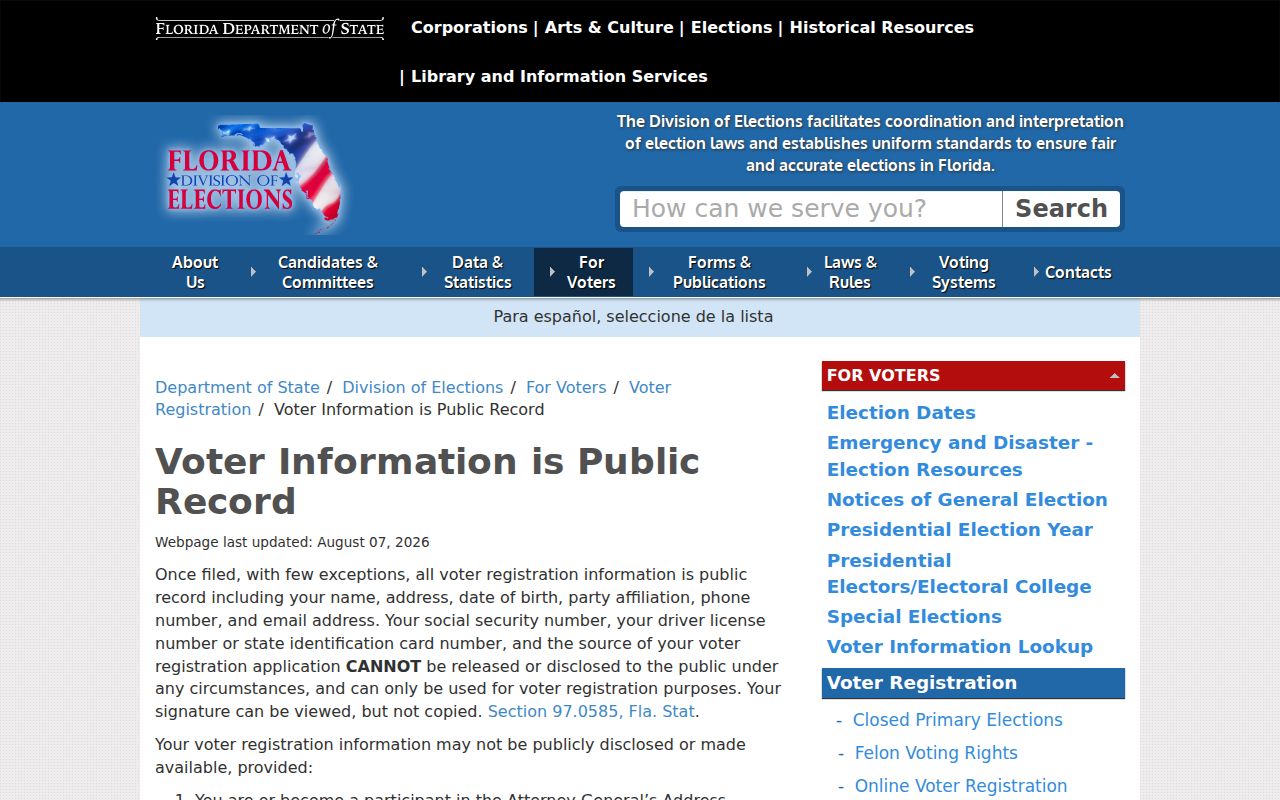
The official guidance separates available registration fields from identifiers and protected addresses that must stay out of public results.
Why Some Melbourne Neighbors Vanish
Florida's Address Confidentiality Program gives qualifying victims of domestic violence and stalking a substitute address and mail forwarding. Voter officials and agencies suppress the true residence as the statutes direct. Some high-risk professionals can also claim address exemptions under section 119.071. Those absences protect real people and must not be bypassed.
A party name can remain in a public index even when an address or image is blocked. The reverse is also possible: a property owner may appear while no occupant data exists. Neither condition proves wrongdoing or concealment. Record the source limitation and stop there.
Note: A gap caused by a lawful exemption is a final result, not an invitation to search private data.
Melbourne Block Permits and Code Files
Permit and code records can add a dated layer to several parcels. Within incorporated Melbourne, the Building Division and Code Compliance Division handle address-based files. Ask by street address, parcel ID, permit number, approximate dates, and case disposition. For an unincorporated parcel or another municipality, contact that jurisdiction instead.
These files may name an applicant, contractor, owner, manager, or correspondent. They do not prove that person lived at the site. Across a block, permit dates can show construction phases, additions, storm repairs, or open cases. Use them to understand the built setting and verify events, not to create a household list.
Older Melbourne Neighbors in Directories
Central Brevard Library's Hill-Donnelly criss-cross directories place listed subscribers in address and phone order. The held years run from 1969 through 2006 with several gaps. Because the collection is not searchable by name, browse the street and house-number sequence to reconstruct an older block. Record the volume year and exact subscriber spelling.
The directory reflects telephone and publisher practices. It can omit unlisted homes, renters, and other residents. Melbourne's 1969 consolidation with Eau Gallie also matters: older northern neighborhoods may be cataloged or described under Eau Gallie. Search both locality names. Do not force a historic entry into today's municipal boundary.
Melbourne Neighborhood Contact Layer
Neighborhood organizations connect residents through meetings, public officers, projects, and local notices. Research surfaced useful community frames such as Eau Gallie Arts District, Downtown Melbourne, Bowe Gardens, Crane Creek, Lake Washington, Suntree-adjacent areas, and master-planned communities. It did not verify a city page promising public member directories. List only public group contacts and ask the organization directly about participation.
City neighborhood contacts
Use the City of Melbourne neighborhood page for current public contact routes. Confirm the group and service area before relying on it.
Library and local history
The Brevard genealogy collections hold old directories, newspapers, and local records that can rebuild a past block.
Private community groups
HOA, congregation, watch, and club rosters stay private unless members choose to publish them. Request contact through the organization, not through a public-record demand.
Public board or business contacts show civic affiliation, not residence. Consent is the right route for an unpublished neighbor roster.
Melbourne Neighbors Across City Lines
A Melbourne postal address can sit in West Melbourne, Melbourne Village, or unincorporated Brevard. Nearby beachside municipalities also share regional labels without being part of Melbourne. USPS confirms delivery. BCPAO's municipal or taxing field and GIS boundary determine the government jurisdiction for the parcel.
This distinction affects permit, code, and records requests. Two homes that feel like neighbors may report to different local offices. Annexation can change jurisdiction without changing the mailing city or ZIP. Check each parcel before comparing city services or asking for files.
Official Melbourne Neighbor Evidence
Commercial neighbor tools often combine stale deed, voter, and marketing data. Their output can merge names, miss protected people, and attach an old address to a current household. Official sources are narrower, but each comes with a custodian, a date, and a defined meaning.
| Source type | Strength | Limit |
|---|---|---|
| Official parcel and deed records | Traceable owner and land facts | Ownership does not equal occupancy |
| Official voter data | Dated public registration fields | Not every resident registers; protected records are removed |
| Commercial compilation | Convenient combined hints | Source dates, corrections, and matches may be unclear |
Use the official record for the fact it keeps. If a name is wrong, seek correction from the original custodian rather than repeating the compilation.
Privacy Limits for Melbourne Neighbors
Renters, children, visitors, utility customers, and many household members do not belong in a public neighbor roll. Utility billing information and security-sensitive records can be exempt. Delivery data and motor-vehicle records are not public routes for building a block directory. A map of owners is never a complete map of residents.
Use neighbor records for civic curiosity, consensual reconnection, getting acquainted through public community channels, or personal safety awareness. Verify facts with the office that holds them and respect a person's choice not to publish private details.
Lawful use. Never use Melbourne neighbor information to watch, intimidate, stalk, harass, or harm anyone.